If there is one thing I can’t get enough of, it’s compost for my garden.
I could use tons and tons of it if I had an endless supply.
As you already know, compost is almost always the answer to any soil-related problem in permaculture and regenerative agriculture.
Soil is not fertile enough → add more compost
Soil is not alive → add more compost
Soil is lacking organic matter → add more compost
Soil is not draining well → add more compost
Your spouse complains about your gardening obsession → add more compost
….
So, having some on hand for my garden is always a top priority. And although I produce my own compost, I can’t keep up with the current demand.
The required amounts quickly stack up beyond what I can produce in my backyard.
The standard recommendation is to top up a garden bed with 5cm / 2’ compost when you prep it for growing. On my standard 2.4 x 1.2 raised bed, that’s 0.15 m3 per bed, and I have 15 of these → which is some 2 m3, roughly 2.62 cubic yards for the yearly top up.
That has escalated quickly, for sure!
So, to make up for the shortfall, I have to import some of my compost, which I don’t mind as long as it’s high-quality. But, in the long term, I’d like to produce a big chunk, if not all, of my compost on-site.
To achieve this, I’d need to set up a composting machine that keeps spitting compost.
I’ve set up my simplified composting system, allowing the materials to break down naturally without turning the compost pile frequently or at all. I keep adding stuff, ensuring that browns and greens go into there in the right amounts and that there is enough air. I let it sit for a season and get a compost harvest once a year that I then spread over my beds in the fall.
It’s a simple system I learned from Charles Dowding, and I like the low labor – great results aspect of it. It’s just a matter of scaling it to produce enough for my gardens.
To do so, I’ll need more piles and, more importantly, enough raw materials – browns and greens – to keep feeding it so it can produce.
I figured out the greens part of the equation and have a steady supply of kitchen and garden waste, which can sometimes be overwhelming, but I lack adequate brown materials. I use cardboard and anything else I can get my hands on, like hay or straw, but I have to import all of these, so there is always that risk that I might contaminate my garden with forever chemicals if I don’t pay close attention to the sources.
I’d like to remove that risk off the table and get as many browns as I can from the site itself. This way, I’d know what I’m getting and where it’s coming from, and I could save myself the trouble of just dealing with it and paying for it all.
That’s why I developed my ‘browns flywheel method,’ a system I developed to get a steady supply of clean brown materials that will allow me to produce an endless amount of compost (endless amounts of greens + endless amounts of browns = endless amount of compost)
The best aspect of this is that I don’t need to go out of my way to produce it because the browns are essentially a byproduct of the activities I would be doing anyway, from the things I would be growing anyway. It’s just a matter of connecting those so I get to work less while getting what I need.
So now let me introduce you to my system and how it all works:
STEP 1. Plant a quick-growing windbreak/privacy hedge
On my suburban permaculture homestead, I planted a quick-growing black locust living hedge for privacy and wind protection.
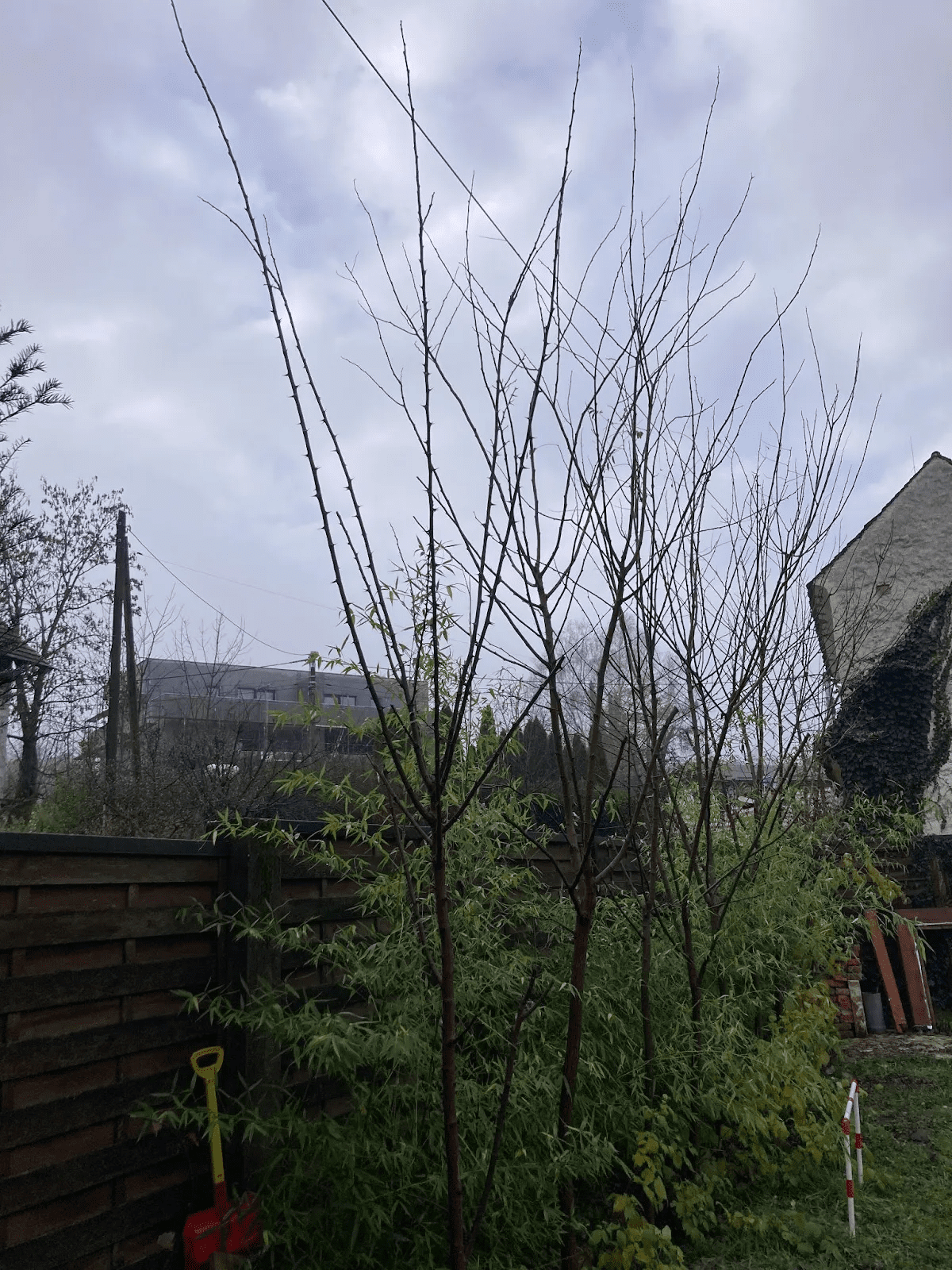
I’ve planted it rather densely with the intention of pruning it heavily so it doesn’t grow too tall and wide. Once a year, after the leaf fall, I prune the tree, which will incentivize it to grow more vigorously next year and will give me an ample amount of sticks and branches to process for my next step.
STEP 2. Pile up all the branches and sticks
I then put all those sticks and branches in one spot and make a pile so they’re out of the way and dry a bit while I’m busy with other fall garden chores.
STEP 3. Make the woodchips
When I’m ready for the next step—processing – I take out my small garden woodchipper and make my browns in batches. I like to make my woodchips small because the smaller you can make them, the quicker they’ll decompose!

You could do this step at any time of the year, but winter is perfect because things are slow, and there isn’t much to do outside except make some noise.
STEP 4**. Let the woodchips sit for a while**
I then let the woodchips sit for a while outside, exposed to the elements. Ideally, you want them to break down a bit before you put them in compost. If you can allow it, ideally, wait for a year or more, but even if you don’t wait that long, there won’t be any harm as they will eventually fully decompose on your garden beds.

In my case, I wait because the black locust is a nitrogen-fixing tree, so I like them to lose some of its nitrogen as I have plenty of that in my green materials.
STEP 5. Add the browns to your compost pile
Now, with browns ready to use and at hand, I toss woodchips in my compost every time I add my greens. Rinse and repeat until the compost pile is at full capacity.

And that’s how you create an endless supply of clean brown materials for your site and a perpetuum mobile composting machine that will supply you with endless compost.
Hopefully this was insightful and got you thinking about implementing this on your site.
If you are interested in establishing these types of simple but smart systems on your land or your garden, I invite you to join my newsletter. There, I share tips like this weekly to help you grow food in less time and with less effort and money invested!
All right, until next time…
– William


